
40HP vs 60HP Outboard Motors: Which Horsepower Is Right for Your Boat?
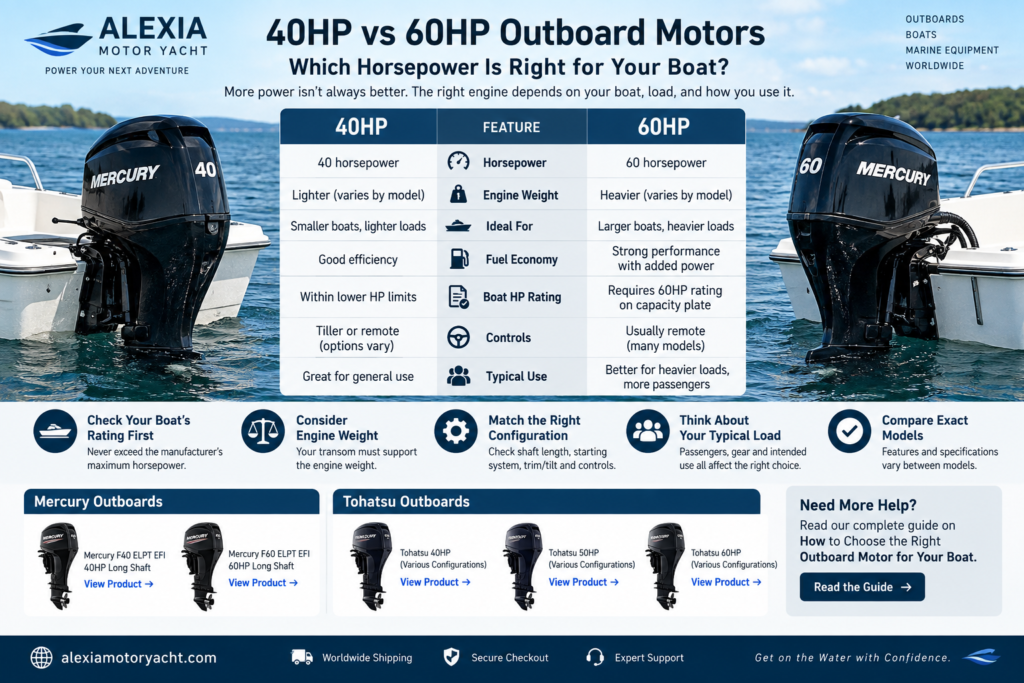
Choosing between a 40HP and 60HP outboard isn’t simply a question of whether more horsepower is better.
The correct engine needs to match the boat manufacturer’s horsepower limits, transom requirements, engine-weight limits, steering system and intended use.
A 60HP engine may offer more available power, but that doesn’t make it appropriate for a boat designed around a 40HP outboard. Likewise, choosing too little power for an application can affect how well the boat performs under its normal load.
This guide explains the key differences to consider when comparing 40HP and 60HP outboard motors.
Start With Your Boat’s Horsepower Rating
Before comparing brands or prices, check your boat’s capacity plate, owner’s manual or manufacturer documentation.
The manufacturer’s maximum horsepower rating is a limit—not a target that every owner needs to reach.
If your boat isn’t rated to accept a 60HP engine, the comparison ends there. Don’t exceed the manufacturer’s stated limit.
You should also check whether the manufacturer specifies a recommended horsepower range rather than looking only at the maximum.
40HP vs 60HP: What Does the Extra Horsepower Change?
Moving from 40HP to 60HP represents a 50% increase in rated horsepower, but that doesn’t mean every aspect of boat performance increases by 50%.
Real-world performance depends on several interacting factors, including:
- Hull design
- Boat weight
- Passenger and equipment load
- Engine weight
- Propeller selection
- Mounting height
- Water conditions
- Weight distribution
The useful question isn’t simply “Which engine is faster?”
It’s whether the additional horsepower is appropriate for your particular boat and normal operating conditions.
When a 40HP Outboard May Make Sense
A 40HP outboard can be appropriate for boats whose manufacturer specifications call for that general horsepower class.
Buyers may consider 40HP when they want to balance available power with engine size and weight while staying comfortably within the boat’s design limits.
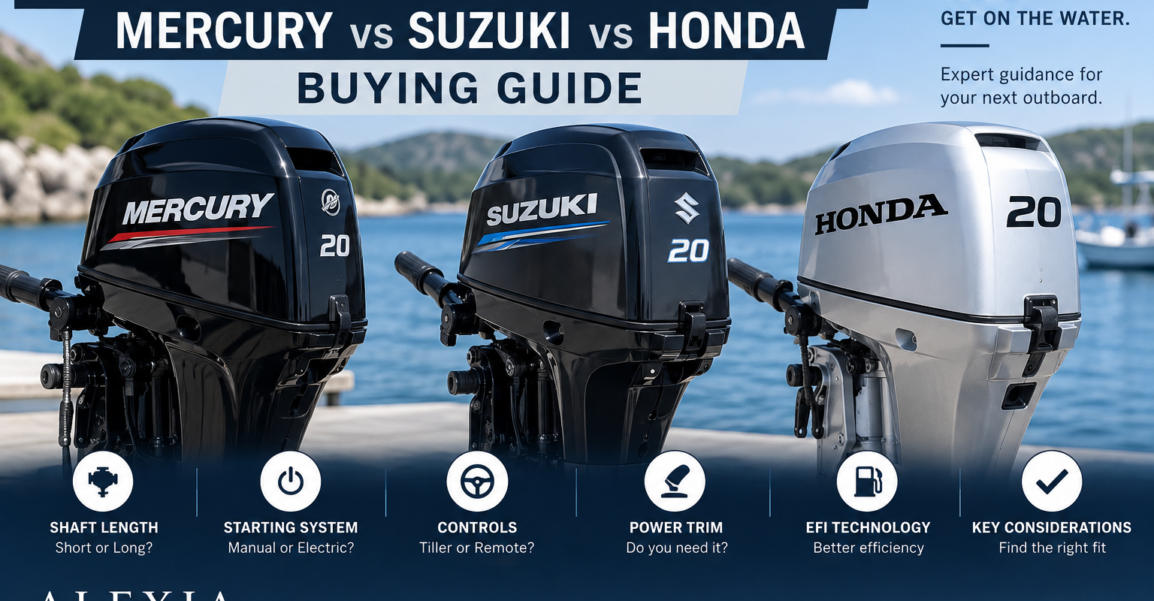
Alexia Motor Yacht currently lists options such as the Mercury F40 ELPT EFI 40HP Long Shaft and several Tohatsu 40HP configurations.
The exact model still matters because two 40HP engines can differ in shaft length, starting system, steering arrangement, trim system and included equipment.
When a 60HP Outboard May Make Sense
A 60HP engine becomes relevant when the boat is designed and rated for the additional horsepower and engine weight.
The extra available power may be useful where the boat regularly carries greater loads or where the hull and intended application call for more power.
Current Alexia inventory includes the Mercury F60 ELPT EFI 60HP Long Shaft as well as multiple Tohatsu 60HP EFI configurations.
Again, horsepower alone doesn’t determine suitability. The complete engine specification needs to match the boat.
Don’t Ignore 50HP
If your boat’s specifications allow different engine sizes within this range, 50HP may also deserve consideration.
Rather than treating the decision as strictly 40HP or 60HP, compare the manufacturer’s recommended horsepower range and determine whether a 50HP configuration provides an appropriate middle option.
Alexia also carries Tohatsu 50HP outboards in different shaft and control configurations.
Compare Engine Weight
Horsepower isn’t the only number that matters.
A higher-horsepower engine may also weigh more, and the boat’s transom needs to support the engine being installed.
Check the published weight for the exact model and configuration you’re considering. Don’t assume every engine with the same horsepower weighs the same.
Weight can also influence balance and how the boat sits and handles.
Always compare the engine against the boat manufacturer’s permitted engine-weight specifications.
Shaft Length Still Matters
A 60HP engine with the wrong shaft length isn’t a better choice than a correctly matched 40HP engine.
The engine’s shaft length needs to correspond with the boat’s transom and mounting arrangement.
Alexia’s inventory includes long-shaft and other configurations, so pay attention to the complete model designation rather than horsepower alone.
If you’re uncertain about shaft length, our How to Choose the Right Outboard Motor for Your Boat guide covers this in more detail.
Tiller vs Remote Controls
At these horsepower levels, many buyers will be looking at remote-control configurations, although exact arrangements depend on the model.
Check whether your boat uses:
- Tiller steering
- Mechanical remote controls
- Electronic controls
- Compatible steering equipment
- Existing gauges and wiring
Changing engine brands or generations can sometimes require additional rigging.
That means the engine’s advertised price isn’t necessarily the complete cost of a repower.
Electric Start, Power Tilt and Power Trim
Features such as electric starting and power trim can significantly affect how an engine is operated.
Power trim allows the engine angle to be adjusted electrically to suit operating conditions and boat attitude.
When comparing engines, confirm whether these features are included in the exact configuration rather than assuming every engine within a horsepower family is equipped identically.
Mercury 40HP vs Mercury 60HP
Alexia currently lists both:
Mercury F40 ELPT EFI 40HP Long Shaft
and
Mercury F60 ELPT EFI 60HP Long Shaft
This provides buyers with a useful same-brand comparison.
Because both belong to Mercury’s four-stroke EFI range, the decision should focus on the boat’s permitted horsepower, engine specifications, weight, intended load and installation requirements rather than simply preferring the larger number.
Tohatsu 40HP, 50HP and 60HP Options
The Tohatsu inventory provides an even broader range within this horsepower band.
Buyers can compare multiple 40HP, 50HP and 60HP configurations, including differences in shaft length and controls.
This is particularly useful when the boat manufacturer permits several horsepower choices because you can narrow the search first by horsepower and then by the required configuration.
40HP vs 60HP Outboard Buying Checklist
Before choosing either engine size, confirm:
- Boat manufacturer’s maximum horsepower
- Recommended horsepower range
- Maximum permitted engine weight
- Required shaft length
- Transom and mounting requirements
- Steering system
- Tiller or remote-control requirements
- Starting system
- Power tilt/trim requirements
- Gauge and wiring compatibility
- Propeller requirements
- Equipment included with the engine
- Installation and rigging costs
- Typical passenger and equipment load
- Current availability and delivery timing
Should You Choose 40HP or 60HP?
There isn’t a universal answer.
If your boat’s manufacturer specifies a lower horsepower limit, that specification determines the appropriate range.
If the boat is designed to accept both 40HP and 60HP options, then consider your typical load, intended use, engine weight, installation requirements and the manufacturer’s recommendations.
A buyer operating lightly loaded may have different priorities from someone routinely carrying passengers, fishing equipment or other significant loads.
The goal isn’t to install the largest engine possible. It’s to install an engine that properly matches the boat.
Compare 40HP and 60HP Outboards
Alexia Motor Yacht currently carries 40HP, 50HP and 60HP outboard configurations across Mercury and Tohatsu.
Compare the exact product specifications rather than horsepower alone, and confirm the model code, shaft length, controls, included equipment, current price and availability before ordering.